
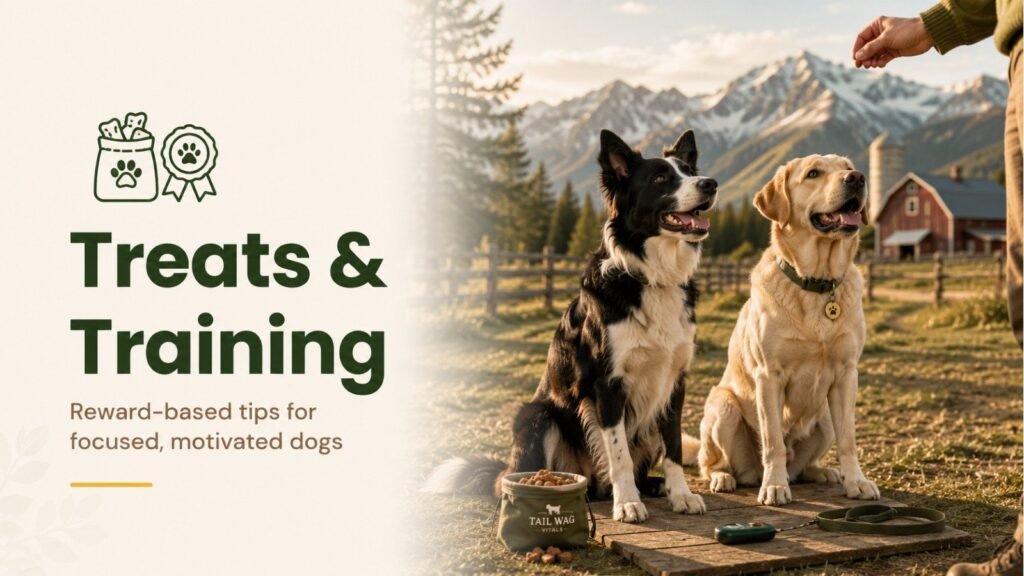
Positive Reinforcement Dog Training: Why Treat Quality Matters
Positive reinforcement has become the dominant, evidence-backed approach to dog training, and for good reason: it works by rewarding the behavior you want rather than punishing the behavior you don’t. But the method only works as well as the reward behind it. A dog that isn’t motivated by what’s in your hand isn’t going to repeat the behavior that earned it, no matter how sound the training theory is. Here’s why treat quality is a bigger factor in training success than most owners realize, and what to look for when choosing rewards.
The Science Behind Positive Reinforcement
Positive reinforcement relies on a simple mechanism: when something the dog values immediately follows a behavior, the dog becomes more likely to repeat that behavior. This isn’t a training philosophy so much as a description of how learning works across most species, and it forms the foundation of force-free and reward-based training methods.
The timing and consistency of the reward matter as much as the reward itself. A treat delivered a few seconds too late can end up reinforcing the wrong behavior entirely, which is why trainers emphasize marking the exact moment a dog does the right thing, whether with a clicker or a verbal marker, before delivering the reward.
Why Reward Value Determines Training Speed
Not all rewards carry the same weight in a dog’s mind. A treat that a dog finds mildly interesting will get mild effort in return, while a treat the dog finds genuinely exciting tends to produce faster learning and stronger recall of the behavior later. This is especially important in distracting environments, like a busy park or a room full of other dogs, where a low-value treat simply can’t compete with everything else pulling at the dog’s attention.
This is also why professional trainers rarely use the same treat for every situation. A treat that works fine for training “sit” in a quiet living room often isn’t strong enough motivation for recall training in an open field.
What Makes a Treat High-Value
High-value treats generally share a few traits: strong smell, intense flavor, and a soft or easily chewed texture that lets a dog eat quickly and get back to training without a long pause. Organ meats tend to check all three boxes, since they carry a much stronger scent profile than muscle meat or processed biscuits.
Freeze-dried organ meat treats fit this description well. Tail Wag Vitals’ Prairie Gold Freeze-Dried Liver is intensely palatable, which is part of why liver has long been a go-to reward among professional trainers and working dog handlers. It comes from the liver of ethically raised, grass-fed cattle sourced from Hutterite farming partners in Wheatland County, Alberta. Tail Wag Vitals freeze-dries the liver without artificial preservatives, giving it a strong natural scent and flavor without relying on added flavoring agents.
Balancing Reward Value with Caloric Load
High-value treats solve the motivation problem, but repetitive training sessions can add up calorically if every reward is rich and dense. As a general guideline, treats of any kind are usually kept to around 10% or less of a dog’s total daily calories, with the rest coming from a complete and balanced main diet. This is where a lean training treat becomes useful. Prairie Air Beef Lung is a high-protein, low-fat organ meat, making it well suited for sessions where a dog receives a large number of small rewards in a short period. Its light, airy texture also means dogs can eat it quickly, which keeps a training session moving instead of pausing for a dog to chew.
Pairing a high-value treat like liver for difficult or high-distraction tasks with a lower-calorie option like beef lung for easier, repeated behaviors is a practical way to keep training effective without overfeeding.
Building a Treat Hierarchy for Training
Trainers often organize rewards into a hierarchy, reserving the highest-value treats for the hardest or most important behaviors, like a reliable recall around distractions or work on a new, unfamiliar skill. Lower-value treats, such as a dog’s regular kibble or a plain biscuit, are typically saved for easier, well-established behaviors the dog already performs reliably.
This approach keeps a dog motivated for the tasks that matter most while avoiding fatigue, which can happen when the same high-value reward is used so often that it starts to lose its impact. Rotating between a small number of high-value, whole-food treats also helps maintain a dog’s interest over the course of a longer training program.
Practical Considerations for Training Sessions
Treat size matters as much as treat type. Rewards used for repeated training should be small enough to eat in one or two bites, since a dog stopping to chew a large treat breaks the flow of a session and slows down the number of repetitions possible in a given amount of time.
Freeze-dried treats also have a practical advantage during training: they don’t require refrigeration and hold up well in a treat pouch over the course of a walk or a longer outdoor session, unlike soft, moist treats that can become messy or spoil if left out.
Treat quality is an important piece of the training puzzle, but it isn’t the only one. If a dog continues to struggle with a behavior despite consistent, high-value rewards and good timing, that’s usually a sign to bring in a certified professional trainer rather than simply upgrading the treat again.
For owners building out a training routine, having a couple of go-to treats on hand, one higher-value option and one lower-calorie option, covers most scenarios without needing to carry an entire assortment. Both Prairie Gold Freeze-Dried Liver and Prairie Air Beef Lung are available through the Tail Wag Vitals, and questions about which treat fits a specific training goal can be directed to the team through the Contact Us page, with responses guaranteed within 24 hours on business days.
Frequently Asked Questions
Why does treat quality matter in dog training?
The quality and value of a treat directly affects how motivated a dog is to repeat a behavior, especially in distracting environments. A low-value treat may work for easy, familiar behaviors, but it often isn’t strong enough motivation for harder tasks like recall around distractions.
What makes a good positive reinforcement treat?
Strong smell, intense flavor, and a texture that’s quick and easy to chew are the main traits of an effective training treat. Organ meats like liver tend to meet all three, which is part of why they’re commonly used in professional training.
Do dogs train better with high-value treats?
Generally, yes, particularly for difficult behaviors or high-distraction environments. Higher-value rewards tend to produce faster learning and stronger motivation, though lower-value treats still have a place for reinforcing behaviors a dog already performs reliably.
How do I build a treat hierarchy for training?
Reserve your highest-value treats for the hardest or most important behaviors, and use lower-value rewards, like regular kibble, for easier, well-established behaviors. This keeps a dog motivated where it matters most and helps avoid treat fatigue from overusing the same high-value reward.
What treats do professional trainers recommend?
Professional trainers and working dog handlers widely use organ meat treats like freeze-dried liver because of their high palatability and nutritional density. They often pair lean options like beef lung with them to manage caloric intake during longer training sessions.
How many training treats is too many in one session?
There’s no fixed number, since it depends on the treat’s size and calorie content, but keeping overall daily treat intake to roughly 10% or less of a dog’s total calories is a reasonable guideline. Using small, low-calorie pieces allows for more repetitions without overfeeding.
Can I use my dog’s regular kibble as a training treat?
Yes, and many trainers recommend it for easier, well-established behaviors. Kibble works well as a lower-value reward in a treat hierarchy, saving higher-value options like freeze-dried liver for harder tasks or high-distraction environments.