
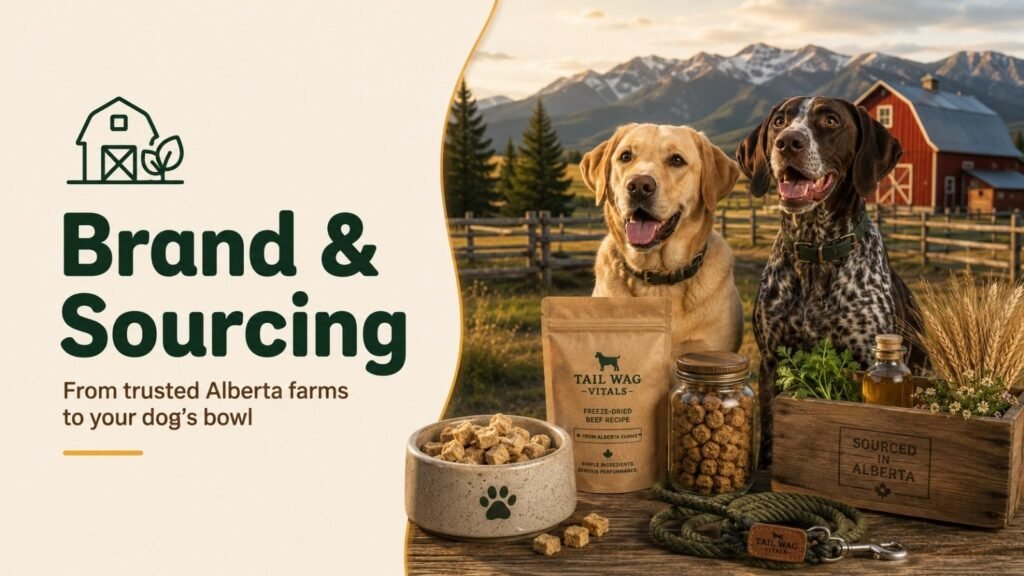
Why 100% Albertan Matters: The Case for Local Pet Food
“100% Albertan. No Exceptions.” isn’t a marketing flourish, it’s a specific operating commitment that shapes every decision about where ingredients come from and how a product gets made. Most pet food brands, even Canadian ones, source at least some ingredients from overseas or import protein through commodity markets. Tail Wag Vitals doesn’t. Here’s what that commitment actually means, why it matters beyond brand loyalty, and what it says about the future of local pet food in Alberta.
What ‘100% Albertan’ Actually Means for Your Dog’s Treats
A geographic claim like this only means something if it’s specific enough to be checked. “100% Albertan” isn’t a badge slapped on packaging after the fact. It describes an actual sourcing structure that starts and ends within the province. The commitment refers specifically to ingredient sourcing, from raw ingredients to freeze-drying to final packaging, rather than every material involved in running the business.
Every Ingredient Sourced Within Alberta: No Exceptions
Every ingredient used across the Tail Wag Vitals range comes from trusted farming partners within Wheatland County, Alberta, with no imported or outsourced components anywhere in the supply chain. This isn’t a partial claim covering just the primary protein while other components come from elsewhere. It’s a full commitment across the entire product, from the raw ingredient through freeze-drying, which is also performed in Alberta, to final hand-packing and shipping. The full range can be browsed on the Tail Wag Vitals shop page.
Why This Commitment Exists
The commitment traces back to the brand’s founding logic: a supply chain that doesn’t cross borders allows the team to trace, verify, and hold every step accountable. Once ingredients start crossing multiple countries through brokers and commodity markets, as is standard practice across much of the mainstream pet food industry, that traceability breaks down. Staying entirely within Alberta isn’t a limitation the brand works around. It’s the structural choice that makes genuine transparency possible in the first place.
The Quality Advantage of Local Sourcing
Geographic proximity between farm and finished product isn’t just a feel-good detail, it converts directly into measurable differences in freshness and accountability.
Shorter Supply Chains and Fresher Products
Every additional step in a supply chain adds time between the source and the finished product, and time is exactly what freshness depends on. A chain that stays entirely within Alberta, from farm to freeze-drying facility to customer’s door, involves far less transit time, handling, and storage than a supply chain crossing multiple countries and passing through several intermediaries along the way. Less time in transit means the finished product more closely reflects the quality of the raw ingredient it started as.
Accountability That Comes from Proximity
A short, local supply chain also involves fewer parties and handoffs between the farm and finished product, making it easier to trace an ingredient back to its source than in a supply chain spanning several countries and multiple brokers, where each party shares responsibility for the ingredient.
Supporting Alberta Agriculture Through Pet Nutrition
Choosing a locally sourced product isn’t only about what ends up in a dog’s bowl. It also determines where the money spent on that product actually goes.
Hutterite Farming Communities and Wheatland County
Every ingredient used by Tail Wag Vitals supports local agriculture in Wheatland County directly, through a sourcing partnership with Hutterite farming communities known for ethical, small-scale, community-based farming practices. This is a fundamentally different economic outcome than a purchase that scatters across international brokers, importers, and distributors before reaching a farm nobody involved in the transaction can even name. A dollar spent on a locally sourced product stays within the community that raised the animal, rather than being distributed across a long chain of intermediaries in different countries.
Why ‘Imported Ingredients’ Should Raise Questions
Many pet food brands, including some marketed as premium or natural, source protein from overseas markets or through domestic brokers who themselves purchase from international suppliers. This isn’t inherently unsafe, importing ingredients is standard, legal practice across much of the food industry, but it does mean those brands cannot offer the same level of traceability that a fully local supply chain can.
When a brand’s ingredient sourcing crosses multiple countries, the specific origin of any given batch can become difficult to pin down, and consistency between batches can vary as sourcing shifts based on cost and availability. A consumer asking “where exactly did this come from” deserves a specific answer, a farm, a county, a named community, and that specificity becomes harder to provide the longer and more international a supply chain becomes. This is worth asking about directly when evaluating any pet food brand’s sourcing claims, regardless of what language appears on the packaging.
The Future of Local Pet Food in Alberta
Interest in traceable, locally sourced pet food has grown alongside the same movement that reshaped how people think about their own food, asking where ingredients come from and who’s accountable for their quality. As more Canadian pet owners research what’s actually in their dog’s treats, brands that use genuine local sourcing can answer those questions more directly than brands that rely on multi-country commodity supply chains.
Alberta’s agricultural base, including its Hutterite farming communities, provides a strong foundation for pet food brands willing to build their entire model around local, traceable sourcing rather than treating it as a premium add-on to an otherwise conventional supply chain. Whether that becomes a broader shift across the Canadian pet food industry or remains a differentiator for a smaller number of committed brands, the underlying demand for traceability from consumers shows no sign of slowing down.
To learn more about the sourcing story behind Tail Wag Vitals, visit the About Us page. You can find the full range of freeze-dried, 100% Albertan treats on Tail Wag Vitals. For sourcing questions, contact the team through the Contact Us page, and the team guarantees a response within 24 hours on business days.
Frequently Asked Questions
What does ‘100% Albertan’ mean for dog treats?
It means every ingredient across the product range comes entirely from Alberta, with no imported or outsourced components anywhere in the supply chain, from raw ingredients through production and packaging.
Why does local sourcing matter for pet food?
Local sourcing shortens the supply chain, which supports fresher products and easier traceability. It also keeps sourcing consistent in a way that long, multi-country commodity chains often struggle to match.
Are Alberta-made dog treats better?
Alberta-made treats aren’t automatically superior simply by virtue of location, but a short, entirely local supply chain does support greater freshness and traceability compared to products sourced through multiple countries and intermediaries.
How does buying local dog treats help Alberta farmers?
Purchasing locally sourced pet food keeps the money spent within the farming community that raised the animal, rather than distributing it across international brokers, importers, and distributors along a longer supply chain.
What’s the difference between local and imported pet food?
Local pet food sourced entirely within one region offers a shorter, more easily traceable supply chain. Imported ingredients often pass through multiple countries and brokers, which can make consistent traceability and accountability more difficult to maintain.
Does ‘100% Albertan’ include packaging and shipping materials too?
The commitment refers specifically to the ingredients themselves, sourced, raised, and freeze-dried entirely within Alberta. It doesn’t make a claim about every material involved in packaging or shipping the finished product.