
Hutterite Farming in Alberta: Why Where Your Dog’s Treats Come From Matters
Hutterite farming Alberta communities have been part of the province’s agricultural landscape for over a century, long before ethical sourcing became a marketing conversation. For a brand built around Hutterite farm dog food, understanding what that partnership actually means matters more than treating it as a nice-sounding phrase on a bag. Where a dog’s treats come from says something real about how the animal behind that treat was raised, and Hutterite colonies represent one of the more distinctive, traceable sourcing relationships in Canadian agriculture today. It’s a relationship built on decades of farming history, not a supply deal signed for a single season.
Who Are the Hutterites: A Brief History
The name shows up often enough in Alberta that most residents recognize it, but the history behind it is worth understanding before talking about what it means for sourcing.
The Anabaptist Farming Tradition on the Canadian Prairies
Hutterites are an Anabaptist Christian group with roots tracing back to the Radical Reformation in 16th-century Europe. What distinguishes them from related groups like the Amish and Mennonites is their commitment to communal living, sharing property and resources within self-sufficient colonies rather than as individual family farms.
After generations of migration across Europe and Russia in search of religious tolerance, many Hutterite communities eventually settled across the Canadian and American prairies in the late 19th and early 20th centuries. Alberta is now home to one of the largest concentrations of Hutterite colonies in Canada, alongside Saskatchewan and Manitoba.
Unlike some other Anabaptist groups, Hutterite colonies generally embrace modern farming equipment and technology, applying mechanized, efficient methods within a communal ownership structure. That combination, modern agricultural practice paired with a centuries-old communal tradition, is part of what makes Hutterite farming distinct from both fully industrial operations and more technology-averse Anabaptist communities.
Community-Based Agriculture and Generational Expertise
A Hutterite colony typically functions as a large, self-sufficient farming community where agricultural work, livestock care, and land management are shared among its members. Farming knowledge is passed down within the colony across generations, building a depth of hands-on agricultural experience that’s harder to find in more transient or corporate farming operations.
Colonies often raise livestock and crops at a scale larger than a typical family farm, while still being managed hands-on by the people who live on and depend on that land, generation after generation, rather than by absentee corporate ownership.
When a colony grows beyond a certain population, it’s common practice to establish a new daughter colony on additional land, effectively splitting the community while preserving the same farming knowledge and communal structure. This pattern has helped Hutterite agricultural expertise spread and deepen across the prairies over the past century, rather than being concentrated in a single location.
How Hutterite Farming Differs from Industrial Agriculture
The distinction isn’t just cultural. It shows up in how animals are raised and how the land is managed day to day.
Animal Welfare Standards on Hutterite Colonies
Because the people managing the herds are also the people who live on that land long-term, often for their entire lives, there’s a direct, personal stake in how animals are raised that’s harder to replicate in operations where ownership and daily management are separated by layers of corporate structure. This kind of proximity between the people making decisions and the animals affected by them tends to produce a more consistent, hands-on standard of care.
It also means the same people are accountable for outcomes year after year. There’s no rotating management team or distant shareholder group making decisions based purely on quarterly output. The incentives line up differently when the people raising the animals are the same people who will be farming that same land for decades to come.
Small-Scale, Sustainable Practices
Relative to the largest industrial feedlot operations, Hutterite colonies operate at a more community-scaled level, with land management decisions made locally by the people working the land rather than dictated from a distant head office. Many colonies integrate crop rotation and mixed livestock-and-grain systems, an approach generally associated with more sustainable long-term land stewardship than single-purpose industrial operations.
That integration matters over the long run. Land that’s managed with crop rotation and mixed use tends to stay productive for longer than land pushed toward a single output year after year, which lines up with a farming community planning for generations rather than a single fiscal year.
The Wheatland County Connection
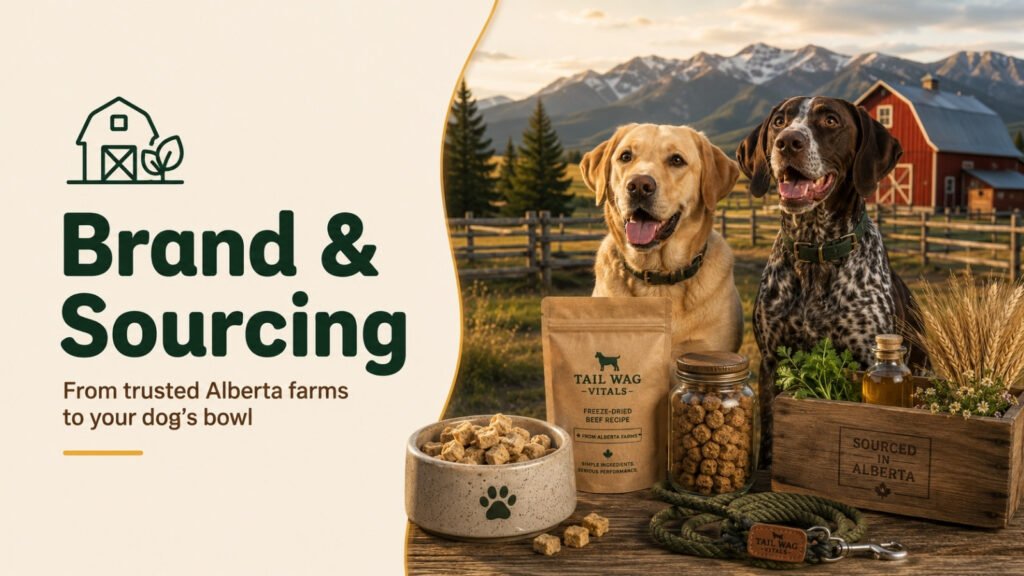
Tail Wag Vitals sources specifically from Hutterite farming partners in Wheatland County, a region in southern Alberta near Calgary and Strathmore. You can read more about how this partnership came together on our About Us page.
Why This Specific Region Produces Premium Protein
Wheatland County sits within Alberta’s prairie grassland belt, land well suited to cattle grazing and the kind of grass-fed operations that produce a different nutrient and fat profile than grain-finished, feedlot-raised cattle. The combination of suitable grazing land and generations of established colony farming tradition in this specific region is part of what makes it a reliable source for the kind of protein used in whole-animal, minimally processed pet treats.
Every ingredient sourced from this region supports the local agricultural economy directly, which is part of why the sourcing location gets named specifically rather than left as a vague “Canadian-sourced” claim. Naming the exact county is a small detail, but it’s the kind of detail that separates a genuine sourcing relationship from a marketing phrase.
Why Sourcing Partnerships Matter for Treat Quality
A named farming partnership isn’t just a nicer story than an anonymous supply chain. It changes what’s actually possible in terms of quality control.
Accountability from Knowing Your Farmer
A direct relationship with a specific farming community allows for a level of traceability and accountability that an anonymous, multi-country commodity supply chain simply can’t offer. If a quality question ever comes up, there’s a known, named relationship to trace it back to, rather than a chain of intermediaries where the original source gets lost somewhere along the way. This is also the reasoning behind eliminating middlemen entirely: buying direct from the farmer means fewer hands the product passes through and fewer points where quality or accountability can slip. If you have questions about how any of our ingredients are sourced, you’re welcome to reach out to our team directly.
This kind of direct relationship also tends to produce more consistent product quality over time, since the same farming partners are supplying batch after batch rather than the source rotating between whichever supplier offered the lowest price that quarter.
Supporting Local Agriculture Through Pet Nutrition
Choosing a treat sourced from a named Alberta farming partnership means the money behind that purchase supports local agriculture directly, rather than an imported or anonymously sourced supply chain. It’s a small decision at the shelf that connects back to a specific place, a specific farming tradition, and a specific community of people who raised the animal behind the treat. If you want to see this sourcing story in more detail, our home page lays out where every product in our lineup actually comes from.
None of this replaces the need to look at a product’s actual ingredient list and nutritional value. But sourcing transparency is a meaningful part of the full picture, and it’s a part that a lot of pet treat brands simply can’t offer because they don’t know, or don’t disclose, exactly where their ingredients came from.
Ethical. Sustainable. Trusted. From our farm to your pet. That isn’t just a line on a page, it’s the reason the sourcing conversation matters in the first place.
Frequently Asked Questions
What is a Hutterite farm?
A Hutterite farm, or colony, is a self-sufficient agricultural community run communally by members of the Hutterite faith, an Anabaptist Christian group with roots in 16th-century Europe. Colonies typically manage large-scale farming and livestock operations collectively rather than as individual family holdings.
Why do Hutterite farming practices matter for dog treats?
Hutterite colonies offer a traceable, community-managed source of protein with generations of established farming practice behind it, rather than an anonymous industrial supply chain. For a treat brand, that translates into more accountability and consistency in how the animals behind the ingredients were actually raised.
Where are Hutterite farms located in Alberta?
Hutterite colonies are found throughout Alberta, with a significant concentration in the province’s southern and central regions. Tail Wag Vitals sources specifically from partners in Wheatland County, located in southern Alberta near Calgary and Strathmore.
How are animals raised on Hutterite farms?
Animals on Hutterite colonies are raised by community members who live on and manage the same land long-term, which supports a hands-on, consistent standard of care. Many colonies combine livestock raising with crop farming as part of an integrated agricultural approach.
What makes Hutterite-sourced ingredients different?
The main difference is traceability and relationship. Sourcing from a named farming community, rather than an anonymous commodity market, means a direct line of accountability from farm to finished product, with fewer intermediaries along the way.