Farm-to-Bowl Pet Food: Why Where Your Dog’s Food Comes From Matters More Than Ever
Farm to bowl pet food is the same idea that transformed how people eat, applied to how their dogs eat, and it arrived for the same reason: people started asking where their food actually came from, and too often nobody could answer. Ethical pet food sourcing follows the farm-to-table logic exactly. Know the farm, shorten the chain, and let the ingredient speak for itself. It’s a simple idea that most of the pet food industry, built on multi-country commodity supply chains and anonymous ingredient brokers, is structurally unable to deliver. This is what the movement actually means, why it’s hard to fake, and how to tell the brands living it from the ones borrowing the language.
What “Farm-to-Bowl” Means Beyond the Marketing
Like every good idea in food, farm-to-bowl attracted imitators the moment it started selling, so the definition needs defending.
Tracing Every Ingredient from Source to Product
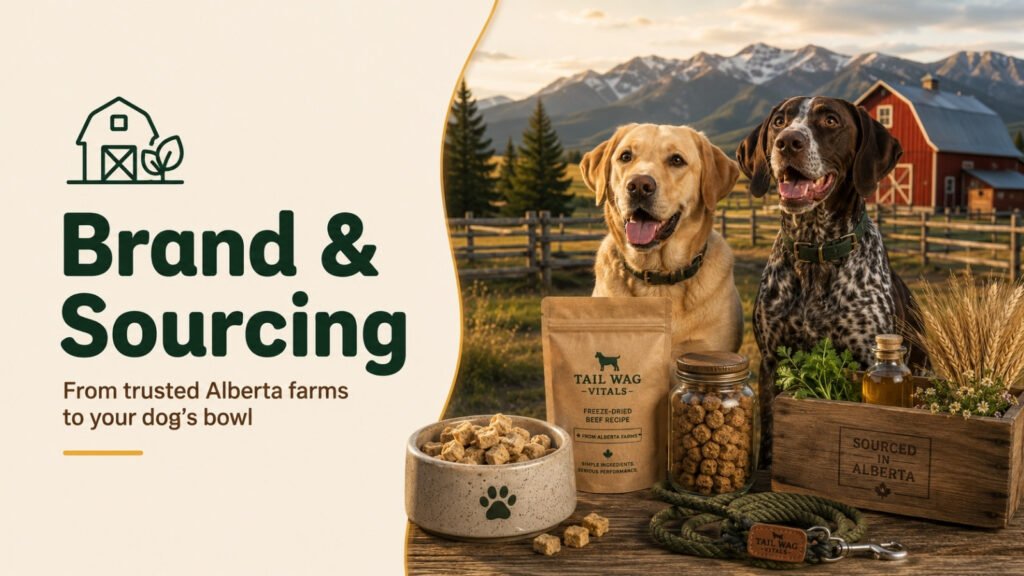
Genuine farm-to-bowl means an unbroken, nameable line from a specific farm to the product in your hand: the region is named, the farming partners are known, and the brand can answer “where did this come from” with a place rather than a shrug. For us, that answer is Wheatland County, Alberta, where our ingredients come from Hutterite farming partners raising ethically kept, grass-fed cattle, a relationship you can read about in full on our About Us page. The test isn’t whether a brand uses the phrase. It’s whether they can complete that sentence with specifics.
Why Most Pet Food Brands Can’t Make This Claim
Most large-scale pet food companies rely on ingredient commodity markets. They purchase proteins and meals through brokers, and those ingredients may cross multiple borders or come from different sources as prices change. Nothing about that structure is secretly sinister; it reflects how commodity manufacturing works. However, it makes genuine traceability difficult to maintain. If a brand does not know which farms supplied its protein this quarter, it cannot give you that information, no matter how earnest the packaging looks. Farm-to-bowl is not simply a premium tier of that model. It follows a different supply model, and that difference explains why relatively few brands can make the claim honestly.
That structure also makes the claim difficult to fake for long. A brand that borrows the language without following the model will struggle when customers ask specific questions. The details either exist or they do not, and no amount of packaging design can create a real county name.
The Three Stages of a Transparent Supply Chain
Our own version of this is the process we call From Ranch to Bowl, and its three stages map onto what any genuinely transparent supply chain has to deliver.
Stage One: The Ranch and Ethical Farming
Everything starts with how the animal was raised, because no later stage can add quality that wasn’t there at the source. Our ingredients begin with ethically raised, grass-fed cattle and turkey from Hutterite farming partners in Wheatland County, communities with generations of hands-on animal husbandry behind them, where the people making daily decisions about the animals are the same people who will farm that land for decades. Sourcing this way honours the whole animal too: using organ meats and whole parts respects the animal and reduces waste, rather than trimming away everything unfamiliar and calling the rest premium.
This stage is also where our whole company started, in a sense. The founding question, asked on a hike in Kananaskis, was why “premium” treats were filled with chickpea flour, glycerin, and artificial flavoring, and the answer traced all the way back to sourcing: brands that don’t control their source can’t control what ends up in the bag. Building from the ranch forward was the only way to build what we couldn’t find.
Stage Two: Preservation That Protects Nutrition
The middle of a supply chain is where most nutrition quietly dies, in high-heat processing, long storage, and the synthetic preservatives required to survive both. Freeze-drying, done in Alberta in small batches, takes a different route: moisture is removed at low temperature through sublimation, locking in nutrients at peak freshness without the cooking that degrades proteins and vitamins, and without needing artificial preservatives to hold the result together. Small-batch matters here as more than a phrase, since it keeps quality control at a scale where individual attention is still possible. The preservation stage should protect what stage one produced, not slowly dismantle it.
Stage Three: Direct Delivery Without Middlemen
The final stage is the shortest sentence in our process: hand-packed and shipped directly to you. No shortcuts. Direct from the butcher to us to you means no distribution warehouses adding months of shelf time, no big box markup layered onto the price, and no point in the chain where responsibility for the product passes to someone who never saw the farm. Every intermediary removed is both a cost saving and, more importantly, one less place where freshness, accountability, or quality can quietly slip.
Why Supply Chain Length Affects Product Quality
Chain length isn’t an abstract supply concern, it converts directly into product outcomes. Every added step means more time between the source and your dog’s bowl, more handling, more storage, and more need for the preservation compromises that long logistics demand. Short chains work in reverse: less time in transit means fresher product, fewer hands means tighter accountability, and a single regulatory jurisdiction, in our case entirely within Alberta, means one consistent standard from ranch to package rather than a patchwork crossed at every border. When something is wrong in a short chain, it’s traceable in days. In a five-country commodity chain, the trail often ends at a broker’s invoice.
There’s a quieter benefit too: a short chain keeps the money in the community that raised the animal. Every ingredient we buy supports local agriculture in Wheatland County directly, which is a different economic story than a purchase that scatters across brokers, importers, and distributors on its way to a farm nobody involved can name.
How to Verify Farm-to-Bowl Claims as a Consumer
The good news is that genuine farm-to-bowl is easy to verify, precisely because real transparency wants to be checked. Ask where the named protein was raised, not packaged, raised, and expect a specific answer: a region, a county, a farming community, not “North American sources.” Look for the sourcing story told in detail on the brand’s own site rather than compressed into a badge on the bag. Check whether the ingredient list is short enough to trace at all, since a forty-ingredient formula sourced from one farm doesn’t exist. And test responsiveness directly: a brand living this model will answer sourcing questions from a real person, happily. Ours does, within a business day, and you’re welcome to try us at our contact page. Real people, real answers, and a genuine willingness to talk about where everything comes from, because when the answer is good, there’s nothing to dodge.
Where your dog’s food comes from was once a question nobody thought to ask. Now that people are asking, the brands with real answers are easy to spot, and if you want to see what a complete answer looks like, product by product, our home page lays the whole story out. Ethical. Sustainable. Trusted. From our farm to your pet.
Frequently Asked Questions
What does farm-to-bowl mean for dog food?
It means an unbroken, traceable line from a specific, named farming source to the finished product: known farms, minimal processing that protects the original nutrition, and direct delivery without layers of intermediaries. The defining feature is specificity, a brand that can name the region and the farming partners rather than gesture at “quality sources.”
Why does supply chain transparency matter for pet food?
Because every anonymous step in a supply chain is a place where quality, freshness, and accountability can slip without anyone being answerable for it. A transparent, short chain means fresher product, consistent standards under one jurisdiction, and a clear trail back to the source if a question ever arises.
How can I trace where my dog’s treats come from?
Start with the brand’s own materials: genuine farm-to-bowl brands name their sourcing region and farming partners specifically and tell the story in detail. Then test it directly by asking, a brand actually living the model will answer sourcing questions specifically and quickly, while a commodity-sourced brand structurally can’t.
What’s the difference between farm-to-bowl and farm-to-table?
They’re the same philosophy applied to different plates: known sources, short chains, minimal processing, and respect for the ingredient, developed first in human food culture and now reshaping pet food. Farm-to-bowl simply extends the standard people adopted for their own meals to what they feed their dogs.