
Pet Food Transparency: What Dog Owners Deserve to Know About Their Treats
Transparency has become one of the most-used words on pet food packaging, yet few brands define it clearly. Industry research from Innova Market Insights found that 62% of pet owners want to know the country where manufacturers actually make their pet’s food. This reflects a broader shift toward clean-label and traceable sourcing claims, which consumers increasingly expect rather than view as a premium extra. However, a word on a bag does not provide the same information as a direct answer to a specific question. Here’s what transparency actually means, what most labels leave out, and how to distinguish a genuine answer from good packaging design.
What Transparency Means in Pet Food Beyond the Buzzword
Real transparency isn’t a tone or a design choice. It’s the ability of a brand to answer a specific question with a specific answer, every time.
Ingredient Origin, Processing Method, and Supply Chain Visibility
Genuine transparency covers three separate things, and a brand can be strong on one while being vague on the other two. Ingredient origin means knowing where a specific ingredient actually came from, not just a country, but ideally a region or farming partner. Processing method means understanding what happens to an ingredient between the farm and the finished product, since heat, additives, and handling can all change what ends up in the bag. Supply chain visibility means knowing how many hands and how many steps sit between those two points. A brand can print “natural” and “premium” without ever addressing any of the three.
The Information Most Brands Won’t Share
Some information is genuinely hard for large-scale pet food brands to provide, not necessarily because they’re hiding it, but because of how commodity ingredient sourcing works.
Where Ingredients Actually Come From
Most large-scale pet food is built on commodity ingredient markets, where proteins and meals are purchased through brokers, frequently sourced across multiple countries, and blended from suppliers that can change from batch to batch based on price. This isn’t a scandal or a hidden conspiracy. It’s simply how large-volume commodity manufacturing works. But it means a brand sourcing this way often cannot tell a customer, with certainty, which specific farm a given batch of protein came from, because that answer genuinely changes over time. A brand that can’t answer “where did this specific ingredient come from” isn’t necessarily being evasive. It may structurally not know.
How Products Are Processed and What That Changes
Processing method matters just as much as origin, and marketing language often goes further than the available evidence. Claims that a process locks in nutrients, preserves enzymes, or eliminates pathogens involve technical questions that require more than a general marketing statement to support them. A transparent brand clearly separates what it believes about its process from what independent testing or verification has actually demonstrated. It does not present both types of claims with the same level of certainty.
How to Evaluate Transparency Claims
Because “transparency” itself isn’t a regulated term, evaluating it comes down to specificity, not vocabulary.
Specific vs Vague – Named Farms vs ‘Trusted Partners’
The clearest test is whether a sourcing claim can be completed with a name or a place. “Trusted partners,” “quality sources,” and “select farms” are all phrases that sound specific without committing to anything checkable. A claim like “Hutterite farming partners in Wheatland County, Alberta” is a different category of statement, because it names an actual region and a real farming community, and it can be verified or disproven. The test isn’t whether a brand uses the word “transparent.” It’s whether the sentence around the claim would still make sense if you asked a direct follow-up question.
Under Canadian regulation, pet food labelling and advertising claims fall primarily under the Consumer Packaging and Labelling Act and the Competition Act, enforced through the Competition Bureau, alongside more limited CFIA oversight focused mainly on animal health and import controls. There’s no mandatory Canadian nutrient standard for pet food, and while many Canadian brands voluntarily reference AAFCO’s model standards for ingredient naming and nutrient profiles, those standards have no legal status in Canada on their own. In practice, this means a lot of the specificity consumers are asking for isn’t strictly required by law, which is exactly why voluntary transparency, or the lack of it, tells you something real about a brand.
Why Transparency Builds Trust and Better Products
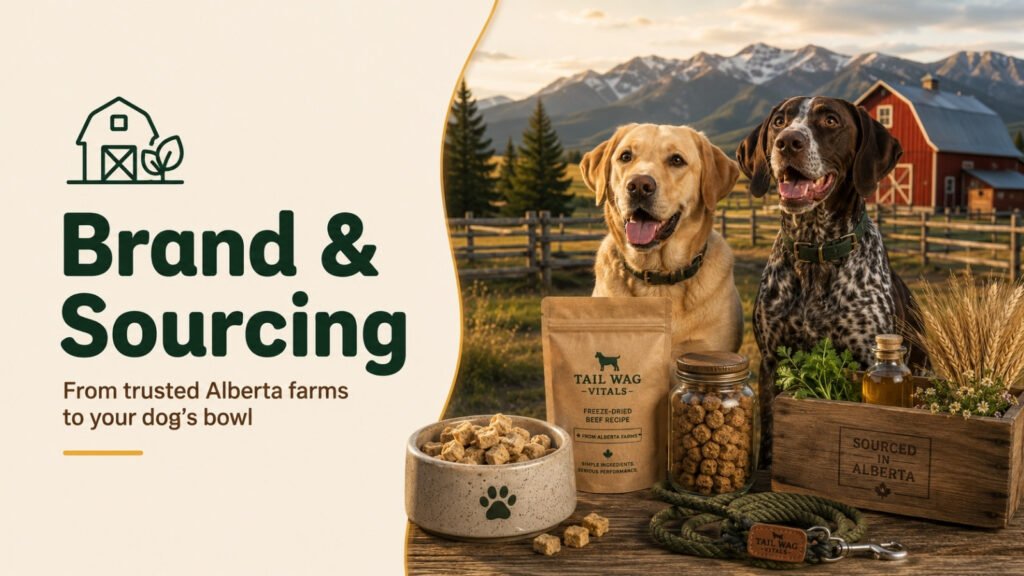
Transparency isn’t just a trust signal for the customer, it also tends to reflect something real about how the product itself was built. A brand that can name its farming region and partners generally has a short enough supply chain to actually know that information, and a short chain also means fewer points where quality or accountability can quietly slip between the source and the finished product. Tail Wag Vitals describes its own sourcing this way: ingredients from Hutterite farming partners in Wheatland County, Alberta, with freeze-drying also done within the province. You can read the full sourcing story on the About Us page, and reach out directly through the Contact Us page with any sourcing questions.
Frequently Asked Questions
What does transparency mean in pet food?
It means a brand can answer specific questions about where an ingredient came from, how the manufacturer processed it, and how many steps separate the farm from the finished product. A transparent brand provides specific, checkable details instead of relying on general marketing language. When a brand names a farming region and partner, it provides more meaningful information than a brand that simply refers to trusted sources.
How transparent are pet food companies about ingredients?
It varies significantly and depends heavily on supply chain structure. Brands sourcing through commodity ingredient markets and brokers often cannot specify exactly which farm a given batch came from, since that can change from batch to batch, while brands with short, direct supply chains are generally able to name their sources specifically. Neither model is inherently dishonest, but they support very different levels of specificity.
Can I trace where my dog’s food comes from?
With some brands, yes, if the brand names a specific sourcing region and farming partner on its own materials and can answer direct follow-up questions about it. With commodity-sourced products, full traceability to a specific farm is often not possible due to how the supply chain is structured, regardless of how the marketing is worded.
What should pet food companies disclose?
In Canada, the Consumer Packaging and Labelling Act and the Competition Act primarily govern pet food labelling and advertising claims, while the Competition Bureau enforces the relevant provisions. The CFIA has a more limited role focused on areas such as animal health and imports. Canada does not have a mandatory nutrient standard specifically for pet food, so companies often choose whether to provide additional details about sourcing, ingredient origin, and processing beyond the information the law requires. The information a company voluntarily shares can therefore provide a useful signal of how transparent it aims to be.